![[back]](/assets/home_24dp_E3E3E3_FILL0_wght400_GRAD0_opsz24.svg "[back]")
![[search]](/assets/search_24dp_E3E3E3_FILL0_wght400_GRAD0_opsz24.svg "[search]")
Drawing Down the Moon
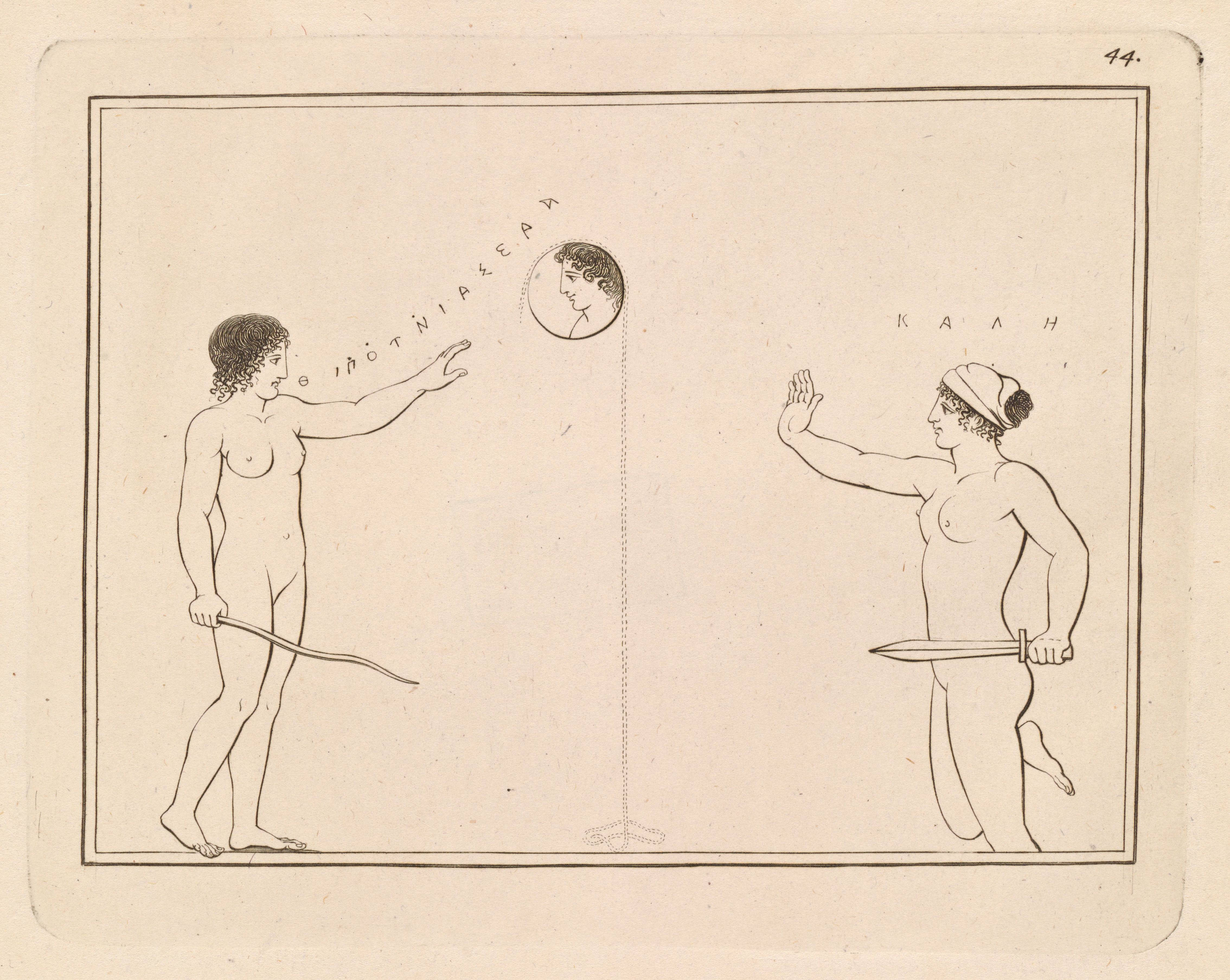
Drawing of two women, one holding a pointed stick and the other a sword, copied from an ancient Greek vase painting
D.E. Hill ("The Thessalian Trick", 1973) says that it depicts the magical practice of drawing down the moon associated in the ancient sources with Thessalian witches
- Erotic Magic
- The ancient image actually gives the Moon-drawing woman a rod/wand
- Drawing down the Moon produces a fluid
- Apuleius independently knows the Moon as something from which witches extract moisture
- And the Moon becomes blood-red during the extraction
- The ῥάβδος itself has the right ritual pedigree
- Aristotle gives us the two female lunar substances we’re interested in
- moon foam - aphro selenon
Erotic Magic
The literary tradition specifically associates Moon-drawing with erotic magic. Ogden’s collection summarizes the ancient topos: Thessalian pharmakides (φαρμακίδες), a term later redefined as "witches", draw down the Moon particularly in erotic attraction magic, and the Moon can become pale or blood-red during the operation.
γυναῖκα φαρμακίδ᾽ εἰ πριάμενος Θετταλὴν
καθέλοιμι νύκτωρ τὴν σελήνην
Strepsiades proposes:
If, having bought a Thessalian pharmakis-woman,
I should bring down the Moon (Selene) by night…
The ancient image actually gives the Moon-drawing woman a rod/wand
The famous Hamilton/Tischbein vase-now lost, but preserved in an 18th-century drawing-is the only surviving ancient image identified by modern specialists as depicting drawing down the Moon. Radcliffe Edmonds uses it as the cover image of his Drawing Down the Moon.
Drawing of two women, one holding a pointed stick and the other a sword, copied from an ancient Greek vase painting
D.E. Hill ("The Thessalian Trick", 1973) says that it depicts the magical practice of drawing down the moon associated in the ancient sources with Thessalian witches
The scene shows two naked women. One carries what the catalog describes as a pointed stick/wand; the other has a short sword. The Moon descends between them.
Drawing down the Moon produces a fluid
Lucan describes what the Thessalian witches actually want from the operation. Under their incantations Luna is forced downward until:
et patitur tantos cantu depressa labores
donec suppositas propior despumet in herbas.
And, pressed/drawn down by incantation, she suffers such travail until, having come nearer, she foams forth onto the herbs placed beneath.
The scholarly discussion explicitly points out that Lucan understands the operation not merely as making Luna disappear but as obtaining the substance produced by her descent.
And then, later in the same book, Erictho actually uses that material.
pectora tum primum ferventi sanguine supplet
vulneribus laxata novis taboque medullas
abluit et virus large lunare ministrat.
“Then first she fills the breast with hot blood, opened by fresh wounds, and washes the marrow of gore, and administers abundantly the lunar virus.”
- lunar fluid / lunar secretion / lunar potent substance
- virus can designate poison, venom, pungent secretion, slime, etc., rather than merely modern “virus.”
And immediately afterward Erictho mixes other pharmacological ingredients into it-rabid-dog foam, lynx viscera, snake-associated substances, dragon eyes, horned-serpent material, etc.
Servius explicitly preserves the pharmacological interpretation when commenting on Vergil’s gathering of magical herbs, which has moon-foam or moon-discharge on them:
herbae enim aut pro lunae ratione tolluntur; aut in quas despumaverit luna
For the herbs are gathered either according to the Moon’s condition, or [those] upon which the Moon has foamed/discharged.
The lunar liquid gets onto the herbs, and those particular herbs are gathered.
He explicitly invokes Lucan’s Moon-drawing passage to explain what kind of herbs he means.
The setting is a φαρμακο-ritual scene performed by a sacerdos. Altars are standing around her; she invokes Erebus, Chaos, triple Hecate/Diana, uses simulated water from Avernus, and obtains special herbs and hippomanes. Vergil writes:
Stant arae circum, et crinis effusa sacerdos
ter centum tonat ore deos, Erebumque Chaosque,
tergeminamque Hecaten, tria virginis ora Dianae.
Sparserat et latices simulatos fontis Averni,
falcibus et messae ad lunam quaeruntur aënis
pubentes herbae nigri cum lacte veneni;
quaeritur et nascentis equi de fronte revolsus
et matri praereptus amor.
Altars stand around, and the priestess, her hair loosened,
thunders forth with her voice three hundred divine powers, Erebus and Chaos,
triple Hecate, the three faces of maiden Diana.
She had sprinkled simulated liquids of the spring of Avernus;
and herbs, harvested according to the Moon, with bronze sickles are sought,
flourishing herbs with the milk/sap of black venenum;
and sought also is the amor torn from the forehead of a newborn horse
and snatched away from its mother.”
Vergil’s ad lunam is what Servius is explaining.
Servius gives two ways of understanding the lunar relationship:
herbae enim aut pro lunae ratione tolluntur; aut in quas despumaverit luna, sicut Lucanus “donec subpositas propius despumet in herbas”
For the herbs are gathered either according to the condition/cycle of the Moon, or [they are herbs] upon which the Moon has foamed/discharged, as Lucan [says]: ‘until, having come nearer, she foams/discharges onto the herbs placed beneath.’”
Then Servius clarifies:
And ‘according to the Moon’ does not mean ‘at night,’ but according to observation of the Moon.
Apuleius independently knows the Moon as something from which witches extract moisture
The commentary on Apuleius Metamorphoses 1 notes another formulation: the witch can effectively dry the Moon of her dew/moisture. The commentary compares other ancient passages where witches obtain lunar dew and notes that such lunar moisture was associated with drugs, erotic preparations and poisons.
magico susurramine amnes agiles reverti, mare pigrum colligari, ventos inanimes expirare, solem inhiberi, lunam despumari, stellas evelli, diem tolli, noctem teneri
By magical whispering, swift rivers [are made] to turn backward, the sluggish sea to be bound, lifeless winds to expire, the Sun to be restrained, the Moon to be made to foam forth, the stars to be torn out, the day to be removed, the night to be held.
And the Moon becomes blood-red during the extraction
Ogden’s survey of the ancient evidence identifies this as one of the standard features of the topos:
drawing down is associated particularly with erotic magic, and the Moon becomes either pale or blood-red during the operation.
We’re accumulating a rather specific cluster:
female pharmakis
→ naked female operator
→ rod/wand
→ erotic rite
→ Moon drawn downward
→ Moon becomes blood-red
→ Moon expresses fluid/foam
→ fluid is collected
→ virus lunare
→ combined with pharmacological ingredients
→ administered
And separately:
woman’s reproductive physiology
→ menstrual κάθαρσις explicitly synchronized by Aristotle with lunar φθίσις
→ female filling synchronized with lunar πλήρωσις
That makes the bodily-pharmacological interpretation worth taking seriously.
The ῥάβδος itself has the right ritual pedigree
The Greek ῥάβδος isn’t merely an emblem held decoratively by witches.
Circe’s operation in Homer combines:
- φάρμακα + ῥάβδος
and the rod participates in producing the altered state/transformation. Scholarship on Circe’s ῥάβδος points out that the same category of implement is used by Hermes, Athena and Poseidon in operations affecting consciousness/state; Hermes’ ῥάβδος famously induces and releases sleep.
So:
- ῥάβδος + pharmakon + altered state
is genuinely archaic Greek.
Then the Moon-drawing image gives us:
- naked woman + rod/wand + lunar operation.
ῥάβδος isn’t simply a generic walking stick. Jane Harrison made the useful distinction that the ῥάβδος is the active implement of enchantment: Circe uses a ῥάβδος in conjunction with her pharmakon when transforming Odysseus’ companions.
Aristotle gives us the two female lunar substances we’re interested in
Aristotle explicitly discusses both.
First, menstruation. He says τὰ καταμήνια are the female analogue of male semen:
ὅτι μὲν οὖν ἐστὶν ἐσχάτη τροφὴ τὸ αἷμα τοῖς ἐναίμοις, τοῖς δ᾽ ἀναίμοις τὸ ἀνάλογον, εἴρηται πρότερον· ἐπεὶ δὲ καὶ ἡ γονὴ περίττωμά ἐστι τροφῆς καὶ τῆς ἐσχάτης, ἤτοι αἷμα ἂν εἴη ἢ τὸ ἀνάλογον ἢ ἐκ τούτων τι.
It has already been said that blood is the final nourishment in blooded animals, and the analogous substance in bloodless animals; and since generative material [γονή] is also a residue of nourishment, and of the final nourishment, it must therefore be blood, or its analogue, or something derived from these.
Then Aristotle gets even more explicit about σπέρμα:
It is clear, therefore, that sperma is a residue of the blood-nourishment, the final nourishment distributed to the parts.
Necessarily, therefore, the blood-like discharge occurring in the female is also a residue.
Here Aristotle states the relationship between καταμήνια and σπέρμα extraordinarily plainly:
For in females, the purging of the menses is an outlet of sperma; for the menses are unconcocted sperma, as was said previously.
- Aristotle, Generation of Animals 4.5
Within his physiology, he explicitly classifies menstrual material as σπέρμα in an unconcocted state.
and explains both through blood-derived generative material. Semen is ultimately produced from nutritive material reduced to αἷμα, and menstrual material occupies the corresponding generative position in the female.
So:
- αἷμα → generative material → male σπέρμα / female καταμήνια.
But then Aristotle immediately discusses another female fluid produced during sexual pleasure.
He says some people believe women emit σπέρμα during intercourse because women sometimes experience pleasure like men and simultaneously emit liquid:
Ὃ δ’ οἴονταί τινες σπέρμα συμβάλλεσθαι ἐν τῇ συνουσίᾳ τὸ θῆλυ διὰ τὸ γίγνεσθαι παραπλησίαν τε χαρὰν ἐνίοτε αὐταῖς τῇ τῶν ἀρρένων καὶ ἅμα ὑγρὰν ἀπόκρισιν, οὐκ ἔστιν ἡ ὑγρασία αὕτη σπερματικὴ ἀλλὰ τοῦ τόπου ἴδιος ἑκάσταις. ἔστι γὰρ τῶν ὑστερῶν ἔκκρισις, καὶ ταῖς μὲν γίγνεται ταῖς δ’ οὔ.
As for what some suppose-that the female contributes sperma in intercourse, because sometimes there occurs in them pleasure similar to that of males and, at the same time, a liquid discharge-this moisture is not spermatikos, but is particular to the place in each woman. For it is a discharge from the hystera, and it occurs in some women but not in others.”
He then disagrees (above with "this moisture is not spermatikos") that this particular ὑγρὰ ἀπόκρισις is semen, calling it instead a female ἔκκρισις associated with the reproductive region.
He argues against those who classify this fluid as female σπέρμα-which importantly tells us that some people in Aristotle’s time apparently did interpret the emission as female sperma.
And he specifically says that in some women its quantity can greatly exceed an emission of semen.
And the quantity, in those women in whom it occurs, is sometimes not comparable to an emission of sperma, but greatly exceeds it.
- αἷμα / καταμήνια - menstrual material, whose evacuation Aristotle explicitly correlates with lunar waning.
- ὑγρὰ ἀπόκρισις / ἔκκρισις - the clear/liquid female emission Aristotle explicitly says can accompany sexual pleasure, sometimes abundantly.
Thus “drawing down Selene” could potentially play upon drawing forth/down the woman’s lunar-correlated generative material (menses).
the clear female emission remains a serious second candidate because Aristotle independently attests a substantial ὑγρὰ ἀπόκρισις associated specifically with female sexual excitation.
The rod makes the 2nd more likely...
- see Hyma for more Aristotle on blood and semen as life essences, semen as a more refined version of blood.
The female lunar substances may also be 1. hyma blood and 2. another clear hyma life essence (non-spermatos) refined version of that blood. By extension.
moon foam - aphro selenon
An interesting word is that for "moon foam".
ὁ δὲ ἀφροσέληνον συλλέγει ἐκ τῆς δρόσου τῶν φυτῶν καὶ τῶν σεληναίων αὐγῶν.
And he collects aphroselēnon from the dew of the plants and the lunar rays.
- ἀφροσέληνον - aphro-selēnon: Moon-foam / lunar foam
What a cool term!